Quick Answer
Göbekli Tepe is the world’s oldest known monumental structure, built approximately 9600 BCE by hunter-gatherers near Şanlıurfa in southeastern Turkey — 7,000 years before Stonehenge and 6,000 years before writing. It features massive T-shaped limestone pillars carved with animals, arranged in circles. Allow 1.5–2 hours on site plus the Şanlıurfa Archaeological Museum for full context. Spring and autumn are the best visiting seasons, and a licensed guide makes the difference between a photo stop and a site you actually understand.
I first visited Göbekli Tepe in 2005, driving down a dirt track through Kurdish villages to reach a hilltop that almost no one in the travel world had heard of. There was no road, no visitor centre, no signage — just ancient stone and a handful of archaeologists quietly brushing soil off T-shaped pillars that had been buried for 12,000 years.
I have returned every year since. Each time, I understand a little more about why this place matters — and why it changes everything we thought we knew about human prehistory.
What Is Göbekli Tepe?
Göbekli Tepe (Turkish for “Potbelly Hill”) is the world’s oldest known monumental structure. Built approximately 9600-8200 BCE, it predates Stonehenge by 7,000 years, the Egyptian pyramids by 7,500 years, and the invention of writing by 6,000 years.
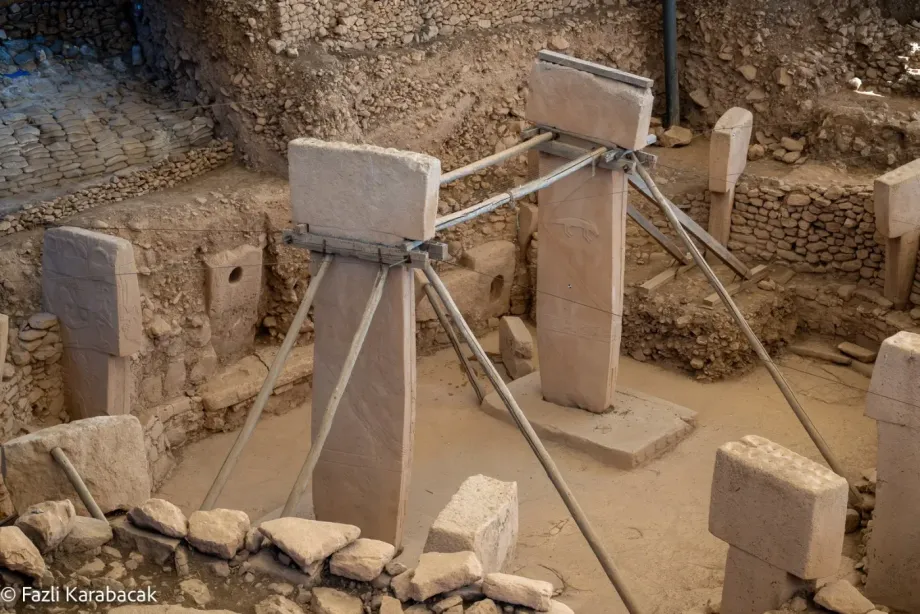
The site consists of massive T-shaped limestone pillars arranged in circles, many weighing 10-20 tonnes. The pillars are decorated with sophisticated carvings of animals — lions, bulls, foxes, snakes, scorpions, vultures — executed with remarkable skill.
Here’s what makes this extraordinary: Göbekli Tepe was built by hunter-gatherers. People who, according to the previous academic consensus, should have been incapable of organized monumental construction.
Why Does It Matter?
Before Göbekli Tepe’s discovery, archaeologists believed that settled agriculture came first, creating the surplus and social organization necessary for monumental architecture. Göbekli Tepe inverts this sequence entirely.
The site suggests that the impulse to build — to create sacred spaces, to gather in large numbers for ritual purposes — may have preceded agriculture. That organized religion and monumental construction may have been the catalyst for settlement, rather than its consequence.
This is not a minor revision. This is a complete rewriting of the story we tell ourselves about who we are and how we came to be this way.
Visiting Göbekli Tepe: Practical Information
Location
Göbekli Tepe is located approximately 15 kilometres northeast of Şanlıurfa in southeastern Turkey, near the Syrian border.
Getting There
- From Şanlıurfa: 20-30 minutes by car
- Nearest major airport: Şanlıurfa GAP Airport (GNY), with connections to Istanbul
- Best approach: As part of a guided tour that includes the Şanlıurfa Archaeological Museum and nearby Karahan Tepe
What You’ll See
The site now has a modern visitor centre and covered walkways protecting the excavated areas. You’ll see:
- Enclosures C and D — the best-preserved circular structures with their central T-pillars
- The carved reliefs — animals, abstract symbols, and the enigmatic “H” shapes
- Ongoing excavation areas — only about 5% of the site has been excavated
Time Needed
Allow 1.5-2 hours at the site itself. Combined with the Şanlıurfa Archaeological Museum (essential for context), plan for a full day.
Best Time to Visit
- Spring (April-May) and Autumn (September-November) offer the most comfortable temperatures
- Early morning visits avoid both heat and crowds
- Avoid midday in summer — temperatures can exceed 40°C
Karahan Tepe: The Sister Site
Twelve kilometres from Göbekli Tepe, Karahan Tepe is currently under active excavation and may prove equally significant. The site features:
- Three-dimensional human faces emerging from stone walls
- A remarkable chamber with eleven pillars surrounding a central carved figure
- Evidence of even more sophisticated construction techniques
Karahan Tepe opened to visitors in 2023. It’s less developed than Göbekli Tepe but arguably more atmospheric — you’re standing at the literal edge of what is currently known.
The Şanlıurfa Archaeological Museum
Don’t skip this. The museum houses the original carved pillars and artifacts from Göbekli Tepe, including the famous “Urfa Man” — the oldest known life-size human sculpture, dating to approximately 9000 BCE.
The museum provides essential context that makes the site visit far more meaningful.
What I Tell My Groups
Standing at Göbekli Tepe, you’re not just visiting an archaeological site. You’re standing at the place where our understanding of human history pivoted.
Twelve thousand years ago, before agriculture, before pottery, before metal tools, people gathered here to build something extraordinary. We don’t fully understand why. We may never understand why. But the fact that they did — that the impulse to create sacred space is this ancient, this fundamental — tells us something profound about what it means to be human.
That’s why I keep coming back.
Frequently Asked Questions
How old is Göbekli Tepe? The oldest known layer dates to approximately 9600 BCE, which is about 11,600 years old. The site remained in active use for roughly 1,500 years before it was deliberately buried around 8200 BCE. That makes it 7,000 years older than Stonehenge and 7,500 years older than the Great Pyramid of Giza.
Is Göbekli Tepe really a temple? The original excavation director, Klaus Schmidt, called it “the first temple” and that framing stuck. More recent work suggests it may have been both a ritual gathering space and a settlement — the categories we use (temple, town, sanctuary) may not map cleanly onto what the site actually was. What is not in dispute: the pillars were symbolic, the carvings were meaningful, and people travelled here for reasons that were not purely practical.
Can I visit Göbekli Tepe on a day trip from Cappadocia? Yes, but only by flight. From Cappadocia, fly to Şanlıurfa (GNY) via Istanbul, visit Göbekli Tepe and ideally Karahan Tepe, and return the same day or overnight in Şanlıurfa. We run exactly this itinerary — it is long but it works.
Do I need a guide to visit Göbekli Tepe? Technically no — the site has walkways, signage, and a visitor centre. In practice, without context you will see interesting old stones for twenty minutes and then leave. The pillars only come alive when someone explains what is carved on them, why the site was buried, and what the excavators have learned since 1995. This is the most “requires a guide” site I have ever worked at.
What should I see at the Şanlıurfa Archaeological Museum? The Urfa Man statue (world’s oldest life-size human sculpture, roughly 9000 BCE), the original excavated Pillar 43 with its vulture carving, and the reconstructed enclosures. Allow two to three hours. Visit the museum before the site if possible — it builds the mental model you need.
Is Karahan Tepe worth adding to the itinerary? Yes, absolutely. Karahan Tepe is 46 kilometres from Göbekli Tepe and offers a completely different visual experience — three-dimensional human faces carved from bedrock, intact chambers with eleven standing pillars. Together the two sites tell a story neither tells alone.
What is the best time of year to visit? April–May and September–November. Summer temperatures in Şanlıurfa regularly exceed 40°C and the site offers limited shade. Winter is cold but quiet. Avoid Ramadan afternoons if you can — opening hours and local services shift.
Experience Göbekli Tepe with an expert guide. Our Treasures of Ancient Turkey Tour and Göbekli Tepe from Cappadocia Tour both include comprehensive visits to this world-changing site.
Ready to Visit Göbekli Tepe in Person?
If this guide has sparked your curiosity, explore our small group and private tours that include Göbekli Tepe and Karahan Tepe with licensed guide Fazli Karabacak.