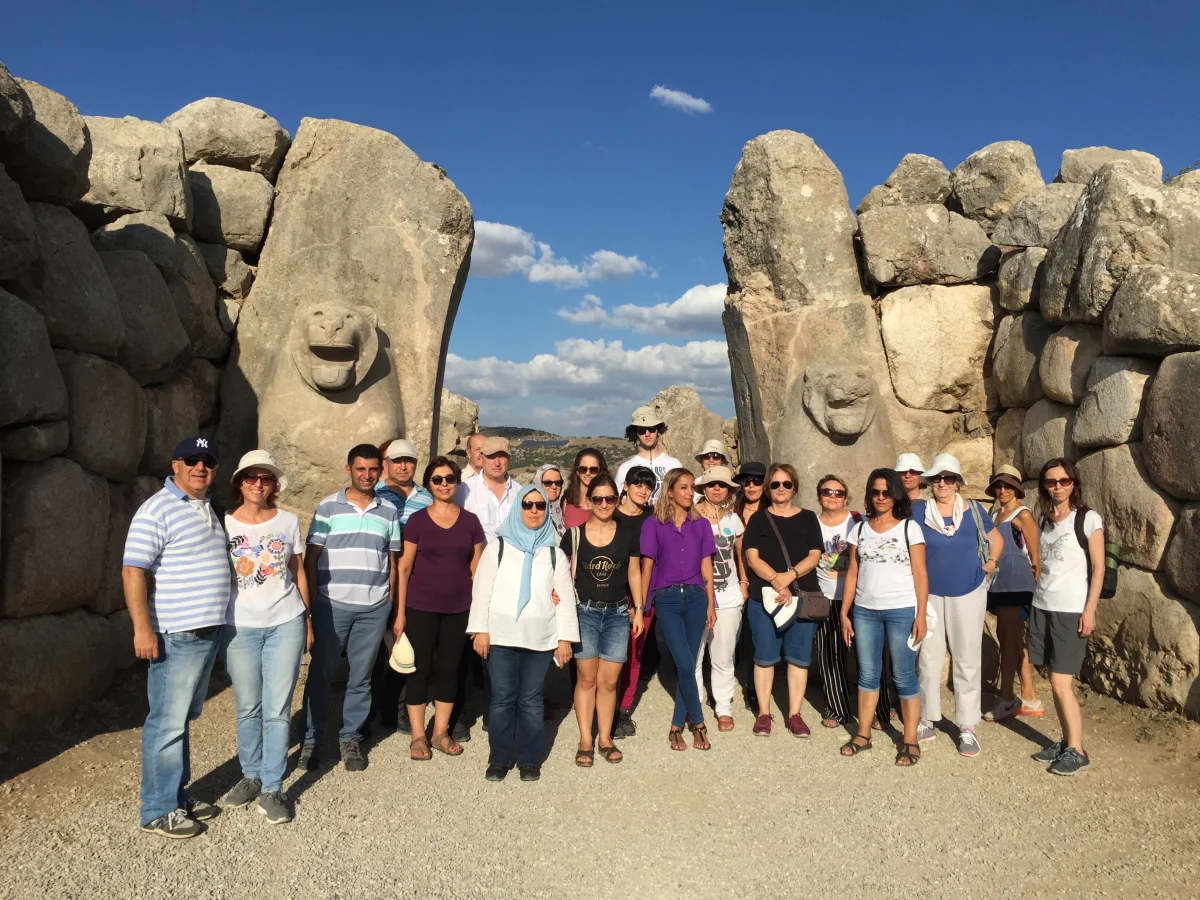
There is a peculiar experience available at the ruins of Hattusa, the ancient Hittite capital in central Turkey. You can stand at the Lion Gate, touch stones laid 3,300 years ago, and contemplate an empire so thoroughly forgotten that its very existence was unknown until archaeologists rediscovered it in the 19th century.
The Hittites ruled much of Anatolia and the ancient Near East from approximately 1650 to 1178 BCE. They were contemporaries and rivals of pharaonic Egypt, inventors of iron working, masters of chariot warfare, and signatories to history’s oldest known peace treaty. And then they vanished — so completely that when the Egyptians, Greeks, and Hebrews wrote their histories, the Hittites were reduced to a handful of vague biblical references.
How does an empire disappear?
The Rise of the Hittites
The Hittites emerged in central Anatolia around 1650 BCE, conquering and unifying the various city-states of the region. Their capital, Hattusa (near modern Boğazkale), became one of the ancient world’s great cities — a massive fortified complex with temples, palaces, and archives containing tens of thousands of clay tablets.
From this base, the Hittites expanded relentlessly. They conquered Babylon in 1595 BCE (a raid so swift that they retreated before they could hold it). They pushed south into Syria, bringing them into direct conflict with Egypt.
The Battle of Kadesh and History’s First Peace Treaty
In 1274 BCE, Hittite King Muwatalli II and Egyptian Pharaoh Ramesses II met at Kadesh in modern Syria in one of the ancient world’s largest chariot battles. Both sides claimed victory. Neither achieved it.
Sixteen years later, exhausted by continued conflict, Hittite King Hattusili III and Ramesses II signed the Treaty of Kadesh — the oldest known peace treaty between two major powers. The treaty established:
- Mutual non-aggression
- A defensive alliance against third parties
- Extradition of refugees and political prisoners
- Diplomatic recognition of territorial boundaries
Copies existed in both Akkadian cuneiform (the diplomatic language of the era) and Egyptian hieroglyphics. A reproduction hangs in the United Nations headquarters as a symbol of diplomatic history.
The Hittite Achievement
Beyond military power, the Hittites contributed significantly to ancient civilization:
Iron Working: The Hittites were among the first to smelt iron, keeping the technology secret for centuries. This gave them a significant military advantage and laid the groundwork for the Iron Age that followed their collapse.
Legal Codes: Hittite law was remarkably sophisticated, emphasizing compensation over punishment. Their legal tablets show a society grappling with questions of justice that remain relevant today.
Religious Tolerance: The Hittites absorbed the gods of conquered peoples into their own pantheon, calling themselves “the people of a thousand gods.” This tolerance helped maintain their diverse empire.
Diplomatic Innovation: The treaty with Egypt was not an anomaly. The Hittites maintained extensive diplomatic correspondence (the Amarna letters provide invaluable evidence) and developed sophisticated approaches to international relations.
The Collapse
Around 1178 BCE, Hattusa was destroyed and abandoned. The Hittite Empire collapsed almost overnight, part of the broader Bronze Age Collapse that brought down multiple civilizations across the eastern Mediterranean.
The causes remain debated: climate change, drought, famine, invasion by the mysterious “Sea Peoples,” internal rebellion — likely a combination of all these factors creating a cascading system failure.
What followed was a dark age. Writing declined. Trade networks collapsed. And the Hittites — their language, their history, their very existence — were forgotten.
Rediscovery
For three thousand years, the Hittites existed only as scattered biblical references — “Uriah the Hittite,” brief mentions in Genesis and Kings. Scholars assumed they were a minor Canaanite tribe.
Then, in 1834, French explorer Charles Texier stumbled upon the ruins of Hattusa. By the early 20th century, archaeologists had begun deciphering Hittite cuneiform tablets, revealing an entire civilization hidden beneath the soil of central Turkey.
The Hittite archives contained over 30,000 clay tablets — royal correspondence, legal codes, religious texts, diplomatic treaties. An empire emerged from obscurity, and our understanding of the ancient Near East transformed.
Visiting Hattusa Today
Hattusa is a UNESCO World Heritage Site located near the village of Boğazkale, about 150 kilometres east of Ankara. The site is vast — the city walls alone stretched 8 kilometres — and includes:
- The Lion Gate and King’s Gate — monumental entrances with remarkable carved reliefs
- The Great Temple — the largest Hittite temple discovered
- Yazılıkaya — a nearby rock sanctuary with carved processions of gods
- The Royal Archives area — where the clay tablets were discovered
Allow at least half a day. The site requires significant walking on uneven terrain, but the setting — ancient walls against the rolling Anatolian plateau — is unforgettable.
Why the Hittites Matter
Standing at Hattusa, you’re confronted with a profound lesson about history and memory. Here was an empire that shaped the ancient world, that rivalled Egypt at its height, that contributed lasting innovations to human civilization. And it was forgotten so completely that we didn’t know it existed.
What else have we forgotten? What other civilizations lie buried beneath the soil, their achievements erased by time?
The Hittites remind us that history is not a complete record. It’s a fragmentary collection of what survived — and what we’ve managed to rediscover. Every archaeological site in Turkey carries this lesson: there is always more beneath the surface.
Our Grand Turkey Tour includes a comprehensive visit to Hattusa and Yazılıkaya, exploring the Hittite civilization in depth.
Tags
Fazli Karabacak
Licensed Tour Guide · 25 Years Experience
Fazli has been guiding English-speaking travellers through Turkey since 2001. University-trained in archaeology and mythology, he specializes in Turkey's ancient sites — from Göbekli Tepe to Ephesus.
Learn more about Fazli