Quick Answer
Karahan Tepe is a Pre-Pottery Neolithic site in southeastern Turkey, dating to roughly 9400–8000 BCE, and is part of the Taş Tepeler network that also includes Göbekli Tepe. Only about 5% of the site has been excavated, but the discoveries — a 2.3-metre male statue, three-dimensional faces emerging from stone walls, and in October 2025 the first-ever human face carved onto a T-shaped pillar — are rewriting what we know about the Neolithic. It sits 46 kilometres east of Göbekli Tepe and is best visited as a full day from Şanlıurfa alongside its more famous sister site.
Most people who have heard of Gobekli Tepe - the world’s oldest known temple, dating to approximately 9600 BCE - assume they know the full story. A remarkable discovery, yes. A rewriting of human prehistory, certainly. Case closed.
It is not closed. Not even close.
Forty-six kilometres east of Gobekli Tepe, on a limestone plateau overlooking the plains of southeastern Turkey, another site has been quietly emerging from the earth since 2019. Its name is Karahan Tepe. And what archaeologists are finding there is not simply confirming what Gobekli Tepe taught us - it is expanding the story in directions that nobody anticipated.
I have been bringing visitors to this region for over twenty years. I was guiding groups to Gobekli Tepe in 2005, before the asphalt road existed, when you had to navigate dirt tracks through Kurdish villages to reach the site. When Karahan Tepe began to reveal its secrets during the pandemic years, I was already there. I brought some of the first visitors to walk the site while excavation ropes were still up and the archaeologists themselves served as our guides.
What I have witnessed at Karahan Tepe over the past several years has changed how I understand not just archaeology, but what it means to be human.
What Is Karahan Tepe?
Karahan Tepe is a Pre-Pottery Neolithic archaeological site in Sanliurfa Province, southeastern Turkey. It dates to between approximately 9400 and 8000 BCE - making it roughly contemporary with Gobekli Tepe, and possibly even older in some of its phases.
The site covers almost ten hectares. If you include the nearby quarries where the T-shaped pillars were carved, it extends to fifteen hectares - significantly larger than Gobekli Tepe.
Here is the number that stops people in their tracks: as of 2025, only about five percent of Karahan Tepe has been excavated. Five percent. Everything that has made international headlines, every discovery that has appeared on magazine covers and in academic journals - all of it has come from a tiny fraction of what lies beneath this hillside.
Karahan Tepe is part of the Tas Tepeler - the “Stone Hills” - a constellation of approximately twelve interconnected Neolithic sites in the Sanliurfa region that are being investigated as part of a major Turkish government archaeological initiative launched in 2020. Together, these sites represent what many archaeologists now believe was the cradle of organised human settlement.
Why Karahan Tepe Is Not Simply “Gobekli Tepe’s Sister Site”
When Karahan Tepe first entered public awareness, it was frequently described as the “sister site” of Gobekli Tepe. That description, while convenient, understates what makes Karahan Tepe distinct - and in some ways, more extraordinary.
Gobekli Tepe speaks in symbols. Its great T-shaped pillars are carved with animals, abstract forms, and geometric patterns. They are awe-inspiring, ancient, and unmistakably intentional. But they maintain a certain distance. You encounter them the way you encounter a great cathedral: with reverence, from the outside. They do not look back at you.
Karahan Tepe looks back.
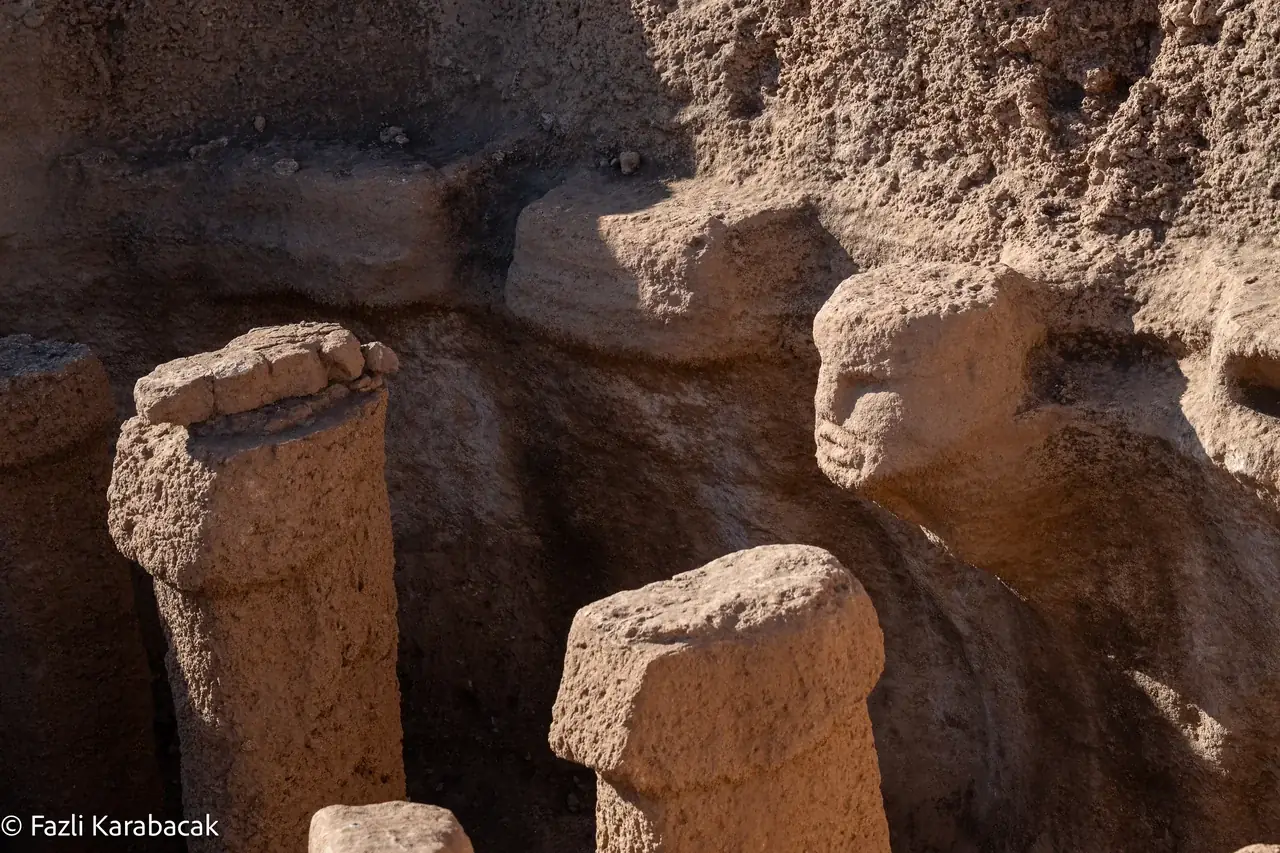
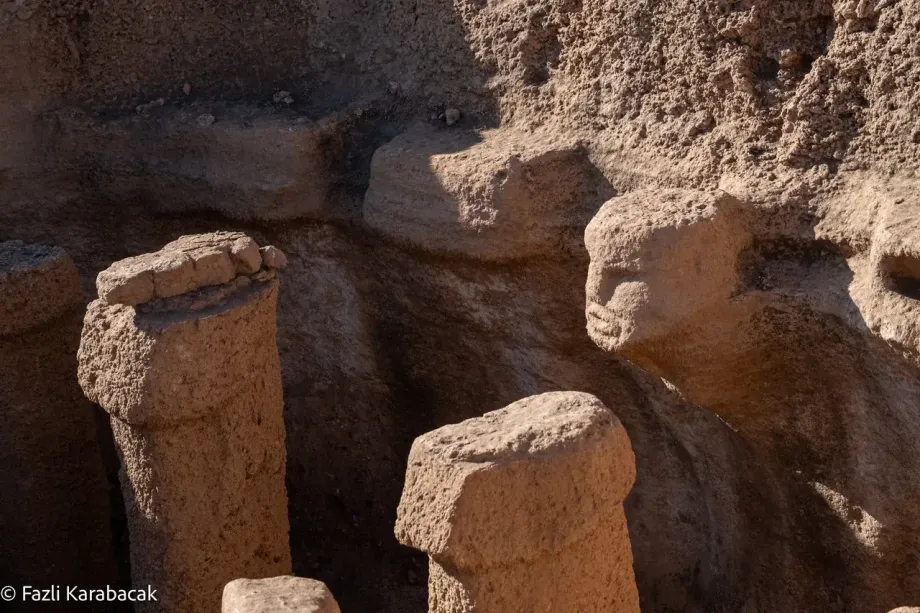
The carvings at Karahan Tepe are faces. Fully realised, three-dimensional human faces that emerge from stone walls as though someone pressed their features against the surface from the other side and pushed through. A 2.3-metre statue with visible fingers and ribs and an expression of unsettling specificity. Heads staring directly outward. Not symbols of people - specific people, rendered by someone who understood the difference.
In October 2025, archaeologists made a discovery that sent shockwaves through the academic world: the first-ever human face carved onto a T-shaped pillar. Professor Necmi Karul, the excavation director from Istanbul University, described it as clear evidence that these pillars were symbolic representations of humans - not merely architectural features. The face featured deep-set eyes, a prominent nose, and a sharp angular jawline. It was the missing piece that confirmed what researchers had long suspected.
And then, just weeks later, a second major human statue was uncovered - matching the same pose and style as the first. A pattern was emerging that could no longer be dismissed.
The Faces That Changed Everything
I want to try to explain what makes these discoveries different, because I think the distinction matters in a way that is difficult to articulate.
Every time I stand in front of the carved faces at Karahan Tepe, the same thought returns. It is simple, and I have stopped trying to make it sound more complicated than it is:
Eleven thousand years ago, someone sat in front of this stone and chose to carve a face. Not an animal. Not a pattern. A face. Someone they knew. Someone they needed to remember. Someone whose existence felt too important to leave only to memory - which they already understood, because they were human, was unreliable.
We do not know whose faces these are. We may never know. But the impulse behind them - the need to say this person was here, this person mattered, I refuse to let them disappear - is not ancient at all. It is the most recognisable human instinct I have ever seen carved in stone.
This is what separates Karahan Tepe from virtually every other ancient site I have guided visitors to over twenty-five years. It does not just show you what people built. It shows you who they were.
What Has Been Found: The Key Discoveries
The excavations at Karahan Tepe, led by Professor Necmi Karul and his team from Istanbul University, have produced a remarkable series of finds since formal digging began in 2019.
The site features T-shaped pillars similar to those at Gobekli Tepe, but with distinct architectural elements. Carved stone benches line the walls of ritual enclosures. Intricate water channels are cut into the bedrock, suggesting sophisticated engineering capabilities that predate agriculture. Serpent motifs are carved into surfaces throughout the site.
Among the most significant individual discoveries: a 2.3-metre tall statue - often called the “Corpse Statue” - found seated in a ritual chamber with ribs visibly exposed. This is considered one of the earliest realistic depictions of the human form ever found. A vulture statue with wings wrapped around its body, showing remarkable craftsmanship. Stone carvings interpreted as possibly the world’s oldest three-dimensional narrative, suggesting these early communities were already developing complex methods of storytelling through carved stone.
In late 2025, Archaeology Magazine named Karahan Tepe one of the top ten archaeological discoveries of the year - a recognition that placed the site at the centre of global conversation about the origins of settled human life.
Professor Karul has noted that each season of excavation reveals something that redefines what came before. As he told journalists in November 2025: as communities became more sedentary, they gradually placed the human figure and the human experience at the centre of their universe.
The Tas Tepeler Project: A Bigger Picture
Karahan Tepe does not exist in isolation. It is one node in a network of sites that together form the Tas Tepeler - the Stone Hills project.
Launched by Turkey’s Ministry of Culture and Tourism in 2020, Tas Tepeler unifies the archaeological investigation of twelve interconnected prehistoric sites in the Sanliurfa region. The project has demonstrated that this area was home to dense Neolithic populations with continuous occupation spanning approximately 1,500 years.
Beyond Gobekli Tepe and Karahan Tepe, the project includes sites like Sayburc, where a relief depicting a human figure grasping a leopard was discovered, and Sefer Tepe, where a double-headed stone slab has added fresh insight into the symbolic world of these ancient communities.
Turkey’s Culture Minister has described the Tas Tepeler region as the future “Neolithic capital” of the world. Major exhibitions have already taken place - including a show at the Colosseum in Rome that drew six million visitors - with upcoming exhibitions planned for Berlin’s James-Simon Gallery in 2026 and Tokyo National Museum in 2027.
This is a living archaeological story, still being written in real time. Coming to Karahan Tepe now means standing at the edge of what is currently known - not the edge of what was known fifty years ago and made accessible for tourists.
Visiting Karahan Tepe: What You Need to Know
Karahan Tepe is located near the village of Yagmurlu, approximately 46 kilometres east of Gobekli Tepe and about 45 minutes by road from Sanliurfa. It is reachable as a day trip from Sanliurfa, and most archaeological tour itineraries combine it with Gobekli Tepe on the same day.
The site has a visitor centre where recent finds are displayed and contextualised. The infrastructure has improved significantly since I first brought visitors here during the early pandemic years, though it retains the feeling of a working archaeological site rather than a polished tourist attraction - which, for the right kind of traveller, is precisely the appeal.
The best months to visit are April through June and September through November, when temperatures in southeastern Turkey are comfortable for outdoor exploration. Summer months can be extremely hot, with temperatures exceeding 40 degrees Celsius.
There is no public transport to Karahan Tepe. You will need either a private vehicle, a guided tour, or a hired car from Sanliurfa.
I recommend allowing at least two to three hours at the site itself, plus the travel time from Sanliurfa. If you are visiting both Gobekli Tepe and Karahan Tepe in a single day - which I strongly recommend - plan for a full day.
Why Go Now
There is a window in the life of every great archaeological discovery when visiting means something different from what it will mean twenty or fifty years from now.
Tutankhamun’s tomb was discovered in 1922. If you visit the Valley of the Kings today, you see a completed exhibit - magnificent, but static. The story has been told. Pompeii was excavated across two centuries. When you walk its streets now, you walk through finished history.
Karahan Tepe is not finished. Ninety-five percent of it is still underground. If this site were a novel, we have read the first three pages. Each excavation season turns a new page - and every page so far has contained a surprise.
Professor Karul and his team will continue digging. New chambers will be opened. New carvings will emerge. The story of Karahan Tepe will keep growing for decades.
But there is something irreplaceable about seeing a discovery while it is still being made. Not a monument behind glass - but the past in the act of being found.
That is what Karahan Tepe offers right now, in 2026. I cannot promise it will always feel this way.
Experience Karahan Tepe With an Expert Guide
I have been guiding visitors to southeastern Turkey’s archaeological sites since 2005 - long before most of the world had heard of Gobekli Tepe, and years before Karahan Tepe was open to anyone.
My tours to this region are small groups of maximum 8 people, led personally by me with over 25 years of experience and an academic background in tourism, archaeology and mythology. I do not read from scripts. I share what I have learned from two decades of visiting these sites, reading every excavation report, and building relationships with the people doing the digging.
Our 14-Day Treasures of Ancient Turkey Tour includes a full day at both Gobekli Tepe and Karahan Tepe, along with other extraordinary sites including Catalhoyuk, Cappadocia, Ephesus, and Mount Nemrut. Our Eastern Turkey Tour and Grand Turkey Tour also feature extended visits to the Tas Tepeler region.
If you have questions about visiting Karahan Tepe or would like to discuss a custom itinerary, I am available 24/7:
Australia Office: +61 431 932 629 (Phone & WhatsApp)
Turkey Office: +90 533 637 83 57 (Phone & WhatsApp)
Email: info@serendipitytours.com.au
If Gobekli Tepe is on your list, Karahan Tepe should be too. I would be honoured to take you to both.
- Fazli Karabacak, Serendipity Tours Turkey
Frequently Asked Questions
How old is Karahan Tepe? The site dates to approximately 9400–8000 BCE, making it roughly 11,000 years old and broadly contemporary with Göbekli Tepe. Some phases may be even older — dating is still being refined as excavation expands.
Is Karahan Tepe older than Göbekli Tepe? The short answer is: not definitively, and the question is slightly wrong. Both sites were active across overlapping centuries within the same cultural horizon. Karahan Tepe is not simply “Göbekli Tepe’s sister site”; it is a distinct site with its own architectural and artistic tradition, particularly around the representation of the human figure.
Can you visit Karahan Tepe and Göbekli Tepe on the same day? Yes, and I recommend it. The two sites are 46 kilometres apart, about a 45-minute drive. Most of my travellers visit both in a single day, with a stop at the Şanlıurfa Archaeological Museum for context. A guide makes the difference between seeing scattered stones and seeing a coherent story.
How do I get to Karahan Tepe? There is no public transport. From Şanlıurfa (the nearest city with an airport), it is roughly a 45-minute drive to the village of Yağmurlu. You need either a private vehicle, a hired driver, or a guided tour. The road has improved significantly since 2023.
What has been found at Karahan Tepe? The headline finds include a 2.3-metre male statue, a chamber with eleven T-shaped pillars surrounding a central carved figure, a vulture statue, three-dimensional human faces emerging from stone walls, and — in October 2025 — the first human face ever carved onto a T-shaped pillar. A second matching statue was uncovered weeks later. The excavations, led by Professor Necmi Karul of Istanbul University, are ongoing.
When is the best time to visit? April–June and September–November. Summer temperatures in Şanlıurfa province regularly exceed 40°C and the site has limited shade. Winter is cold but quiet; most travellers prefer the shoulder seasons.
Why visit now rather than later? Only 5% of the site has been excavated. Each season reveals something new. Visiting Karahan Tepe in 2026 means standing at the edge of an ongoing discovery rather than in front of a finished monument. Twenty years from now the site will be more polished but will feel less like a working dig — which, for a certain kind of traveller, is precisely the appeal.