Quick Answer
Taş Tepeler (“Stone Hills”) is the name given to a network of at least twelve Pre-Pottery Neolithic sites in southeastern Turkey, dating to roughly 10,000–8,000 BCE — making them about 12,000 years old. Göbekli Tepe and Karahan Tepe are the two currently open to the public; others such as Sayburç and Harbetsuvan are still active dig sites. Together they show that monumental stone architecture and organised ritual life existed before agriculture, reshaping our understanding of when and how civilisation began. Most travellers visit from Şanlıurfa (GNY airport) and pair the sites with the Şanlıurfa Archaeology Museum.
When Göbekli Tepe was inscribed as a UNESCO World Heritage Site in 2018, it was presented as a singular marvel — the world’s oldest known temple, a one-off, an anomaly. That narrative lasted about two years.
Since 2019, Turkish archaeologists have been systematically surveying and excavating a cluster of related Neolithic sites scattered across the limestone plateaus of southeastern Turkey. Collectively, they are called the Taş Tepeler — the Stone Hills. And what they reveal is not one miraculous site, but an entire civilisation that predates agriculture, pottery, and permanent settlement.
I have been guiding visitors through this landscape for more than twenty years. I was at Göbekli Tepe before the road existed. I stood at Karahan Tepe when excavation ropes were still up and the archaeologists themselves walked us through the finds. What I can tell you is this: the Taş Tepeler discovery is rewriting human history in real time, and we are only at the beginning.
What Are the Taş Tepeler?
Taş Tepeler (Turkish for ‘Stone Hills’) is the umbrella name for a network of at least twelve Pre-Pottery Neolithic sites in the Şanlıurfa region of southeastern Turkey. They date to approximately 10,000–8,000 BCE — making them roughly 12,000 years old.
The name was officially adopted by the Turkish Ministry of Culture and Tourism in 2021 as part of the Taş Tepeler Project, a coordinated national effort to excavate, study, and present these sites to the world.
The confirmed Taş Tepeler sites include Göbekli Tepe, Karahan Tepe, Harbetsuvan Tepesi, Sayburç, Çakmaktepesi, Kurt Tepesi, Gürcütepe, Ayanlar Höyük, Sefer Tepe, Yeni Mahalle, and several others still in early survey phases. They span an area of roughly 200 kilometres across the northern edge of the Mesopotamian plain.
Why Do They Matter?
Before Göbekli Tepe, the standard model of human development went like this: humans settled, invented agriculture, built permanent structures, and then — eventually — developed complex rituals and social organisation. Göbekli Tepe reversed this sequence. Here were monumental stone structures built by hunter-gatherers who had not yet domesticated a single grain of wheat.
The Taş Tepeler network takes this reversal further. Göbekli Tepe was not an isolated miracle. It was part of a widespread cultural system. The people of this region were carving T-shaped pillars, building communal ritual spaces, quarrying and transporting multi-ton stone blocks, and depicting a shared symbolic language of animals and human figures — all before farming, before pottery, before writing.
What the Taş Tepeler project is demonstrating is that the Neolithic Revolution did not begin with agriculture. It began with belief.
The Major Sites
Göbekli Tepe
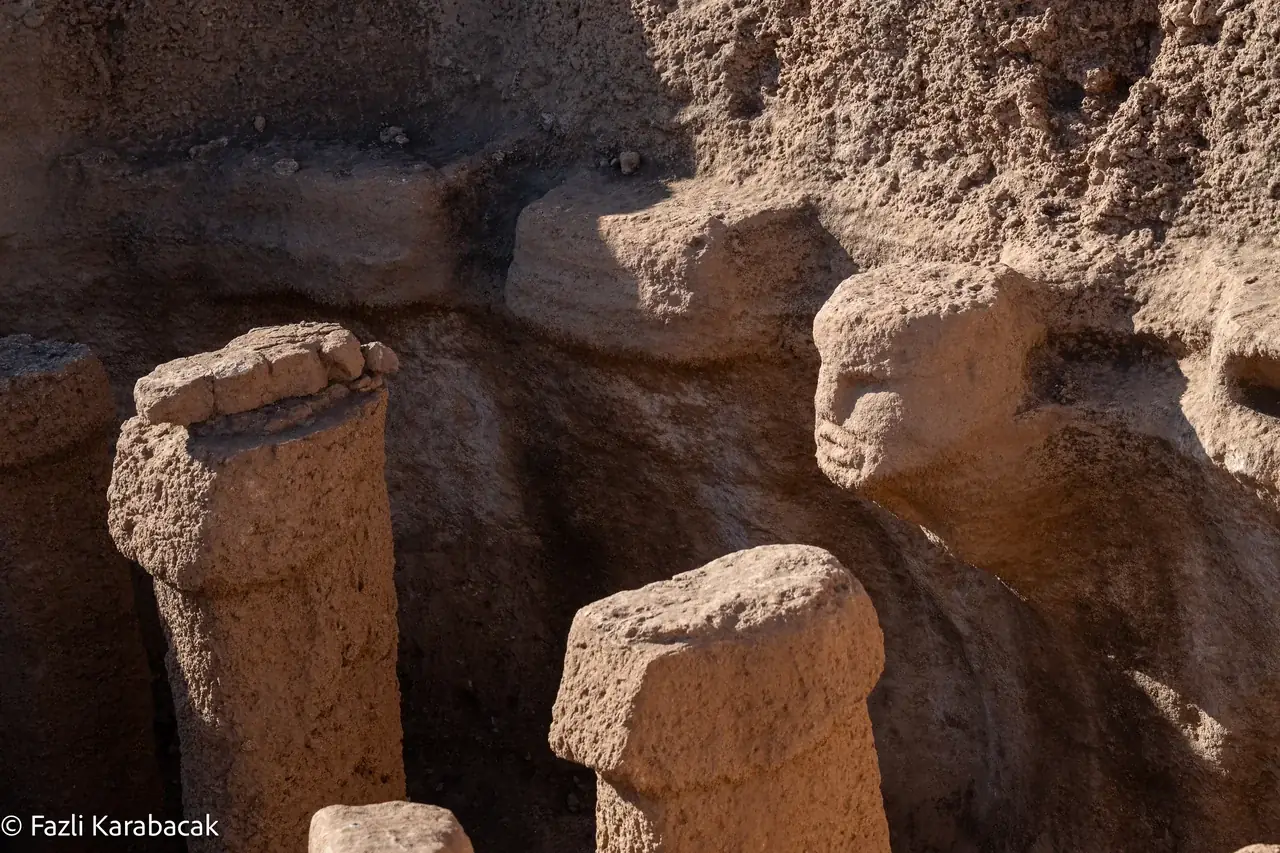
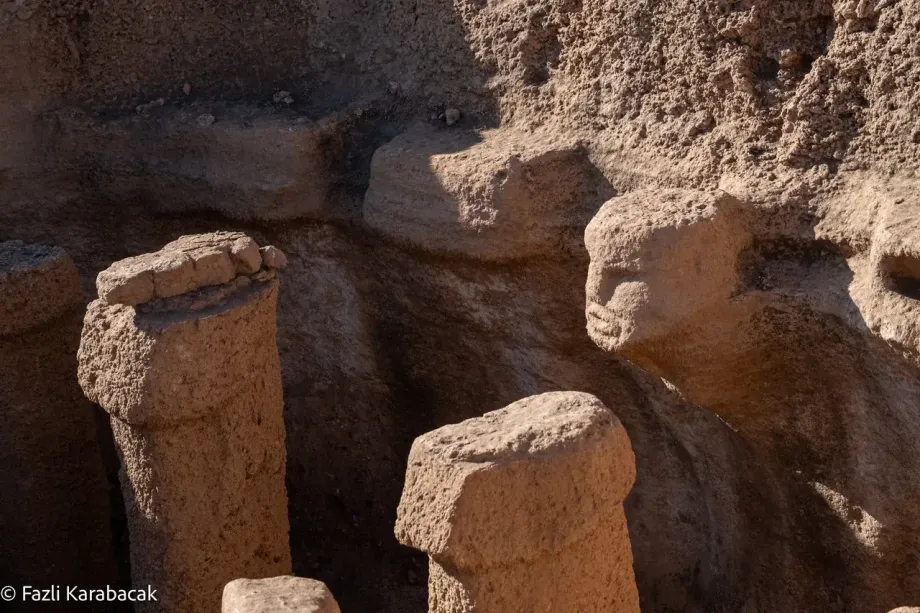
The anchor of the Taş Tepeler network. Discovered by Klaus Schmidt in 1994 and excavated since 1995, Göbekli Tepe features massive circular enclosures with T-shaped limestone pillars up to 5.5 metres tall and weighing up to 16 tonnes. The pillars are carved with reliefs of foxes, lions, snakes, scorpions, and abstract symbols. UNESCO inscribed the site in 2018. Only about 5% of the site has been excavated.
Karahan Tepe
The most dramatic recent discovery. Located 46 km east of Göbekli Tepe, Karahan Tepe was first surveyed in 1997 but serious excavation began only in 2019 under Professor Necmi Karul. The site has revealed Structure AB — a remarkable circular chamber with carved pillars emerging from the living bedrock, including a striking arrangement of phallus-shaped pillars and naturalistically carved human heads. Many archaeologists consider Karahan Tepe equal in significance to Göbekli Tepe.
Harbetsuvan Tepesi
A smaller but significant site approximately 40 km northeast of Şanlıurfa. Harbetsuvan features a communal building with stone pillars and carved reliefs, including depictions of human hands and what appear to be dance scenes. Excavated since 2021.
Sayburç
Perhaps the most visually stunning recent discovery. Sayburç, located beneath a modern village near Şanlıurfa, revealed in 2023 the earliest known narrative relief in human history — a carved stone panel depicting a human figure flanked by a bull and a leopard, telling what appears to be a story. This finding was published in the journal Antiquity and made international headlines.
How to Visit the Taş Tepeler Sites
Getting There
All Taş Tepeler sites are in or near Şanlıurfa Province. The city of Şanlıurfa (often shortened to Urfa) has a domestic airport (GNY) with regular flights from Istanbul, Ankara, and Izmir. Flight time from Istanbul is approximately 2 hours.
What Is Open to Visitors?
As of 2026, two Taş Tepeler sites are fully open to the public: Göbekli Tepe and Karahan Tepe. Göbekli Tepe has a modern visitor centre, walkways over the excavation trenches, and interpretive signage. Karahan Tepe has a more basic setup but is fully accessible.
Sayburç and Harbetsuvan are active excavation sites and generally not open to independent visitors, though guided groups with advance permission from the excavation team have occasionally been granted access.
The Şanlıurfa Archaeology Museum
No visit to the Taş Tepeler is complete without the Şanlıurfa Archaeology Museum. It houses the Urfa Man (the oldest known life-size human sculpture, dating to approximately 9000 BCE), finds from Göbekli Tepe and Karahan Tepe, and a full-scale replica of Göbekli Tepe’s Enclosure D that you can walk inside.
Can You Visit Independently?
You can visit Göbekli Tepe and Karahan Tepe without a guide — both have ticket offices and basic signage. However, the signage is minimal, and without context, what you see is stone pillars in trenches. The significance of the animal reliefs, the spatial arrangement of the enclosures, the relationship between the sites — none of this is obvious without expert interpretation.
This is precisely why our guided tours exist. We combine both major sites with the Şanlıurfa Museum in a single day, with an archaeologically trained guide who can explain what you are looking at and why it matters.
Our Taş Tepeler Tours
We offer the Taş Tepeler experience as both a dedicated day tour from Şanlıurfa and as part of our longer multi-day Turkey itineraries. All tours are limited to a maximum of 8 travellers and led personally by Fazli Karabacak.
The dedicated day tour includes the Şanlıurfa Archaeology Museum, Göbekli Tepe, a traditional southeastern Turkish lunch, Karahan Tepe, and an optional visit to Balıklıgöl and Harran.
For those wanting a deeper immersion, our 14-day Treasures of Ancient Turkey tour and 7-day Göbekli Tepe from Cappadocia tour both include full Taş Tepeler coverage as centrepieces of the itinerary.
View our Taş Tepeler tour options →
The Future of Taş Tepeler
The Turkish government has committed significant resources to the Taş Tepeler Project, designating it a priority cultural programme. New excavation seasons are planned at multiple sites. A dedicated Taş Tepeler visitor and interpretation centre has been proposed near Şanlıurfa.
What makes this moment extraordinary is how much remains unknown. If Göbekli Tepe is only 5% excavated, and Karahan Tepe is perhaps 3% excavated, and there are at least ten more sites in early survey stages — then what we know today is a fraction of what this landscape will eventually reveal.
I have been guiding at these sites long enough to see what was once a footnote in archaeology textbooks become a headline. Taş Tepeler is not just a collection of Neolithic ruins. It is the place where human civilisation, as we understand it, began.
Frequently Asked Questions
What are the Taş Tepeler sites? Taş Tepeler (Turkish for “Stone Hills”) is the umbrella name for at least twelve Pre-Pottery Neolithic sites in the Şanlıurfa region of southeastern Turkey, dating to roughly 10,000–8,000 BCE. The best-known are Göbekli Tepe and Karahan Tepe; others include Sayburç, Harbetsuvan Tepesi, Çakmaktepesi, Sefer Tepe, and Ayanlar Höyük.
Which Taş Tepeler sites are open to visitors? As of 2026, Göbekli Tepe and Karahan Tepe are fully open to the public. Göbekli Tepe has a modern visitor centre and covered walkways; Karahan Tepe has a simpler setup but is fully accessible. Sayburç and Harbetsuvan are active excavation sites and generally not open to independent visitors, though occasional access can be arranged for guided groups with advance permission.
How do I get to Şanlıurfa? Şanlıurfa GAP Airport (GNY) has regular domestic flights from Istanbul, Ankara, and Izmir. Flight time from Istanbul is about 2 hours. From the airport it is roughly 45 minutes to the city centre, and a similar drive out to Göbekli Tepe or Karahan Tepe.
Do I need a guide to visit? Technically no — both Göbekli Tepe and Karahan Tepe have ticket offices and walkways. In practice, without a guide you see stone pillars in trenches. The carvings, the spatial logic of the enclosures, the connections between sites — none of this is obvious from the signage alone. These are the most “requires a guide” sites I have ever worked at.
What is the Urfa Man? The Urfa Man is the oldest known life-size human sculpture, dating to approximately 9000 BCE. He stands in the Şanlıurfa Archaeology Museum, and he is the single most important object you can see before or after visiting the sites themselves. Two obsidian eyes, a carved beard, and a gaze that is impossible to shake.
When is the best time to visit? April–June and September–November. Summer temperatures in Şanlıurfa regularly exceed 40°C and the sites offer limited shade. Winter is cold but quiet, and sometimes atmospheric. The shoulder seasons are when we run most of our tours.
Can I visit all the Taş Tepeler sites in one trip? Not yet. Only Göbekli Tepe and Karahan Tepe are fully public. The dedicated day tour from Şanlıurfa covers both plus the Şanlıurfa Archaeology Museum — which, combined, give you the clearest possible picture of the Taş Tepeler landscape as it is currently understood.
Experience the Taş Tepeler with us on our Treasures of Ancient Turkey Tour, Göbekli Tepe from Cappadocia Tour, or Eastern Turkey Tour.